1.4. Reciprocal Lattice#
The reciprocal lattice is the counterpart of the real-space lattice used to describe waves and diffraction in crystals. We define its primitive translation vectors and show that a plane wave with the periodicity of the lattice must have a reciprocal lattice vector as its wave vector. Finally, for a conventional cell with centering translations, we derive which combinations of the vectors constructed from the cell edges are reciprocal lattice vectors. This gives the reflection conditions for diffraction.
Prerequisites: Lattice Matrix \(A\), Fractional Coordinates, and Centering Translations.
Learning Objectives:
Define the primitive translation vectors of the reciprocal lattice and derive their relation \(B=2\pi A^{-\mathsf T}\) to the lattice matrix.
Show that a function with the periodicity of the lattice can be expanded using only plane waves with reciprocal lattice vectors as wave vectors.
Derive the conditions that integer indices must satisfy to give a reciprocal lattice vector for a conventional cell with centering translations.
Primitive Translation Vectors of the Reciprocal Lattice#
For a given set of primitive translation vectors, define the primitive translation vectors of the reciprocal lattice using the cross products below. These notes follow the convention common in solid-state physics, which includes a factor of \(2\pi\). A convention without this factor of \(2\pi\) is also used in crystallography.
The lattice vectors and reciprocal lattice vectors satisfy the following orthogonality relation.
In the two-dimensional example in Fig. 1.4.1, \(\boldsymbol b_1\) is perpendicular to \(\boldsymbol a_2\). The value of \(\boldsymbol b_1\cdot\boldsymbol r\) changes by \(2\pi\) from one parallel line to the next. This family of lines is the two-dimensional counterpart of the lattice planes that together contain all lattice points. The reciprocal lattice vector is normal to the planes.
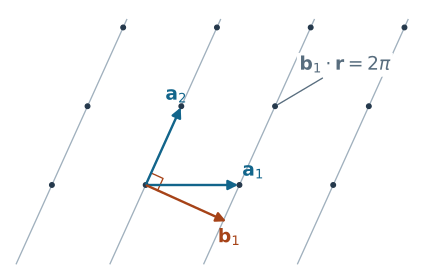
Fig. 1.4.1 The black dots are real-space lattice points. On each gray line, \(\boldsymbol b_1\cdot\boldsymbol r\) is constant. Moving to the next line in the direction of \(\boldsymbol a_1\) increases the dot product by \(2\pi\). The arrow indicates only the direction of the reciprocal lattice vector.#
Arrange the reciprocal lattice vectors as columns, just as for \(A\) in Equation (1.1.2), and define
The orthogonality in Equation (1.4.2) gives the matrix product
It follows that the inverse matrices of \(A, B\) are the transposes of one another divided by \(2\pi\).
Thus \(B=2\pi A^{-\top}\). The fractional coordinates in Equation (1.1.6) also follow from the reciprocal lattice vectors via \(\boldsymbol s=A^{-1}\boldsymbol r=B^\top\boldsymbol r/2\pi\), or component by component as \(s_i=\boldsymbol b_i\cdot\boldsymbol r/2\pi\).
Reciprocal Lattice Vectors and Periodic Functions#
Integer combinations \(\boldsymbol g=B\boldsymbol h\) (\(\boldsymbol h\in\mathbb Z^3\)) of the primitive translation vectors of the reciprocal lattice are called reciprocal lattice vectors. Together they form the reciprocal lattice. The dot product of \(\boldsymbol g\) with a lattice vector \(\boldsymbol R=A\boldsymbol n\) is
Because this is an integer multiple of \(2\pi\), we have \(e^{i\boldsymbol g\cdot\boldsymbol R}=1\) for every lattice vector.
The electron density and potential of a crystal satisfy the relation below for any lattice vector \(\boldsymbol R\):
They are functions with the periodicity of the lattice.
A function with the periodicity of the lattice can be written as a superposition of plane waves \(e^{i\boldsymbol g\cdot\boldsymbol r}\) with reciprocal lattice vectors as wave vectors. This expansion is a Fourier series.
The Fourier coefficient \(\rho_{\boldsymbol g}\) gives the weight of plane wave \(e^{i\boldsymbol g\cdot\boldsymbol r}\). Translation by a lattice vector \(\boldsymbol R\) multiplies every plane wave by \(e^{i\boldsymbol g\cdot\boldsymbol R}=1\). Each term is therefore unchanged, so Equation (1.4.6) holds.
Fig. 1.4.2 shows a one-dimensional example. The second harmonic has half the period of the fundamental. A translation by \(a\) leaves both unchanged. The density given by adding these two components and a constant therefore also repeats every \(a\).
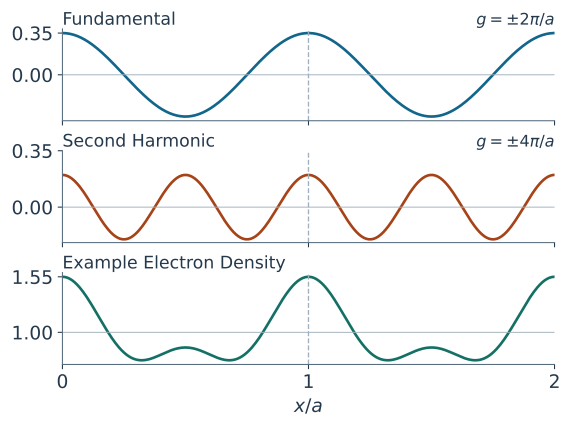
Fig. 1.4.2 In the top panel \(0.35\cos(2\pi x/a)\) corresponds to the pair of plane waves \(g=\pm2\pi/a\). In the middle panel \(0.2\cos(4\pi x/a)\) corresponds to \(g=\pm4\pi/a\). The bottom panel illustrates a density formed by adding these two components and a constant term of 1 at \(g=0\). The vertical dashed lines mark the boundaries of one period.#
Conversely, wave vectors \(\boldsymbol g\) for which \(e^{i\boldsymbol g\cdot\boldsymbol R}=1\) holds for every lattice vector \(\boldsymbol R\) must be reciprocal lattice vectors. Since \(B\) is nonsingular, any \(\boldsymbol g\) can be written as \(\boldsymbol g=B\boldsymbol h\) with real components in \(\boldsymbol h\). Setting \(\boldsymbol R=\boldsymbol a_i\) and using Equation (1.4.2) gives \(\boldsymbol g\cdot\boldsymbol a_i=2\pi h_i\). For this to be an integer multiple of \(2\pi\), \(h_i\) must be an integer. The reciprocal lattice therefore consists of the wave vectors of plane waves whose phase is invariant under every lattice translation. This is also why the Fourier series in Equation (1.4.7) of a function with lattice periodicity contains only plane waves with reciprocal lattice vectors as wave vectors. We use this property in the next section.
Reciprocal Lattice of a Cell with Centering Translations#
Construct \(B_{\rm c}=2\pi A_{\rm c}^{-\top}\) from the edges \(A_{\rm c}=(\boldsymbol c_1,\boldsymbol c_2,\boldsymbol c_3)\) of the conventional cell by the same cross products as in Equation (1.4.1). When there are centering translations, these vectors are not a set of primitive translation vectors for the reciprocal lattice because the edges of \(A_{\rm c}\) alone do not generate every translation of the lattice. The property derived in the previous section tells us which indices correspond to reciprocal lattice vectors.
Equation (1.1.8) writes a lattice vector as \(\boldsymbol R=A_{\rm c}(\boldsymbol n+\boldsymbol\tau)\) (\(\boldsymbol n\in\mathbb Z^3\), \(\boldsymbol\tau\in T\)). Writing the wave vector as \(\boldsymbol g=B_{\rm c}\boldsymbol h_{\rm c}\), we obtain the following from \(A_{\rm c}^\top B_{\rm c}=2\pi I\):
This is an integer multiple of \(2\pi\) for all \(\boldsymbol n\) and \(\boldsymbol\tau\) if and only if \(\boldsymbol h_{\rm c}\) has integer components and
Even when the components of \(\boldsymbol h_{\rm c}\) are integers, \(B_{\rm c}\boldsymbol h_{\rm c}\) is a reciprocal lattice vector only if this condition holds.
For BCC, \(T=\{(0,0,0),(1/2,1/2,1/2)\}\), so \(h+k+l\) must be even. For FCC, the three face-centering translations require \(k+l\), \(h+l\), and \(h+k\) all to be even. Equivalently, \(h,k,l\) must be all even or all odd. For example, \(B_{\rm c}(1,0,0)^\top\) is not a reciprocal lattice vector for FCC, but \(B_{\rm c}(2,0,0)^\top\) and \(B_{\rm c}(1,1,1)^\top\) are.
The condition in Equation (1.4.8) is the reflection condition on the indices allowed by the centering translations in diffraction. The section Cancellation by Centering Translations derives the same condition from the sum of the phases of scattered waves from atoms related by centering translations.
References#
IUCr, Reflection conditions.